View Single Post
  #1  
Old 09-03-2009, 03:43 AM
.BZU.'s Avatar
.BZU. .BZU. is offline


Join Date: Sep 2007
Location: near Govt College of Science Multan Pakistan
Posts: 9,693
Contact Number: Removed
Program / Discipline: BSIT
Class Roll Number: 07-15
.BZU. has a reputation beyond repute.BZU. has a reputation beyond repute.BZU. has a reputation beyond repute.BZU. has a reputation beyond repute.BZU. has a reputation beyond repute.BZU. has a reputation beyond repute.BZU. has a reputation beyond repute.BZU. has a reputation beyond repute.BZU. has a reputation beyond repute.BZU. has a reputation beyond repute.BZU. has a reputation beyond repute
Read Mean Deviation,Stander Deviation of the Data and Some More Concepts about statistic Data

Mean Deviation,Stander Deviation of the Data and Some More Concepts about statistic Data
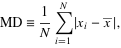
The mean deviation (also called the mean absolute deviation) is the mean of the absolute deviations of a set of data about the data's mean. For a sample size Name:  Inline1.gif
Views: 419
Size:  316 Bytes, the mean deviation is defined by
Name:  NumberedEquation1.gif
Views: 422
Size:  1.8 KB (1)

where Name:  Inline2.gif
Views: 428
Size:  283 Bytes is the mean of the distribution. The mean deviation of a list of numbers is implemented in Mathematica as MeanDeviation[data].
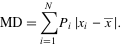
The mean deviation for a discrete distribution Name:  Inline3.gif
Views: 406
Size:  321 Bytes defined for Name:  Inline4.gif
Views: 431
Size:  351 Bytes, 2, ..., Name:  Inline5.gif
Views: 437
Size:  316 Bytes is given by
Name:  NumberedEquation2.gif
Views: 401
Size:  1.7 KB (2)

Mean deviation is an important descriptive statistic that is not frequently encountered in mathematical statistics. This is essentially because while mean deviation has a natural intuitive definition as the "mean deviation from the mean," the introduction of the absolute value makes analytical calculations using this statistic much more complicated than the standard deviation
Name:  NumberedEquation3.gif
Views: 403
Size:  2.1 KB (3)

As a result, least squares fitting and other standard statistical techniques rely on minimizing the sum of square residuals instead of the sum of absolute residuals.
For example, consider the discrete uniform distribution consisting of Name:  Inline6.gif
Views: 422
Size:  277 Bytes possible outcomes with Name:  Inline7.gif
Views: 419
Size:  1.1 KB for Name:  Inline8.gif
Views: 425
Size:  351 Bytes, 2, ..., Name:  Inline9.gif
Views: 429
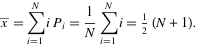
Size:  316 Bytes. The mean is given by
Name:  NumberedEquation4.gif
Views: 417
Size:  2.3 KB (4)

The variance (and therefore its square root, namely the standard deviation) is also straightforward to obtain as
Name:  NumberedEquation5.gif
Views: 414
Size:  2.3 KB (5)

On the other hand, the mean deviation is given by
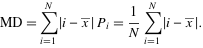
Name:  NumberedEquation6.gif
Views: 428
Size:  2.3 KB (6)

This can be obtained in closed form, but is much more unwieldy since it requires breaking up the summand into two pieces and treating the cases of Name:  Inline10.gif
Views: 405
Size:  277 Bytes even and odd separately.
The following table summarizes the mean absolute deviations for some named continuous distributions, where Name:  Inline11.gif
Views: 409
Size:  1.2 KB is an incomplete beta function, Name:  Inline12.gif
Views: 424
Size:  1.1 KB is a beta function, Name:  Inline13.gif
Views: 395
Size:  1.6 KB is a gamma function, Name:  Inline14.gif
Views: 393
Size:  309 Bytes is the Euler-Mascheroni constant, Name:  Inline15.gif
Views: 415
Size:  1.6 KB is a Meijer G-function, Name:  Inline16.gif
Views: 399
Size:  2.2 KB is the exponential integral function, Name:  Inline17.gif
Views: 411
Size:  1.2 KB is erf, and Name:  Inline18.gif
Views: 418
Size:  1.5 KB is erfc.
__________________
(¯`v´¯)
`*.¸.*`

¸.*´¸.*´¨) ¸.*´¨)
(¸.*´ (¸.
Bzu Forum

Don't cry because it's over, smile because it happened
Reply With Quote